
There is a particular silence that falls over grown adults at the threshold of a made world. I felt it in Tokyo, at the entrance to the Warner Bros. Studio Tour — the place they call, quite plainly, The Making of Harry Potter. One moment we were a queue of tired travellers, checking our phones, minding the heat. The next, the Great Hall opened in front of us and the whole line went quiet, the way a congregation goes quiet. No one had asked us to. Wonder does that on its own.
I had not expected it to work on me. I came, if I am honest, as a mother indulging a memory — prepared to admire the craftsmanship and stay, somehow, above it. I did not stay above it. Somewhere between the floating candles and the long oak tables and the grey-gold light through those tall windows, my chest tightened, and I was, for a moment, eleven years old again and certain the world held more rooms than I had been shown.
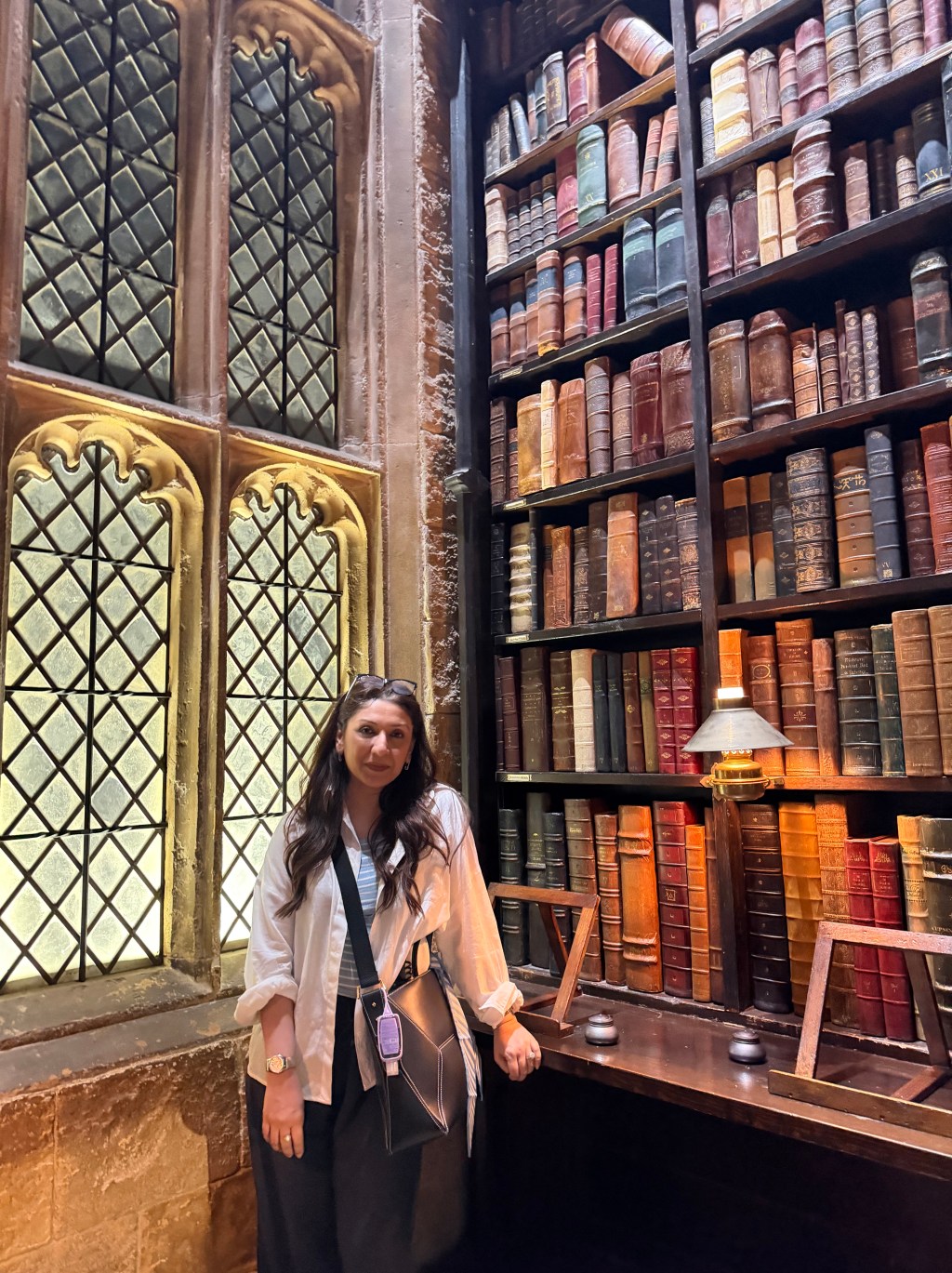
There is a library on the tour — a real one, or real enough. Shelves climb past the reach of any ladder; the spines are cracked and gilded; a reading lamp sits still warm at the desk, as though someone had only just stepped away. I stood in it for a long time. It is, of course, a set. Every book a prop. Every shadow placed by a designer who had done the arithmetic of awe. And knowing this changed nothing at all. That is the part the cynic never quite believes: that wonder survives its explanation. You can know exactly how the trick is done and still feel the floor tilt beneath you.
We tear one cathedral of wonder down and build another on the same ground. We cannot seem to help ourselves.
I learned the rest only afterwards, and it has stayed with me longer than the castle. The Studio Tour stands on the grounds of Toshimaen, an amusement park that enchanted the children of Tokyo for ninety-four years, from 1926 until it closed in 2020 to make room for this. Ninety-four years of summer queues and carousel music dismantled, so that a different machinery of delight could rise in its place. Step back far enough and the story stops being about a film at all. It becomes about us: a single plot of earth that human beings have insisted, for a century, on making into a place of wonder.
As a physiologist I could give you the mechanism, the dopamine of novelty, the way an unexpected pattern lights the brain, the reward anticipation pays out before the thing itself arrives. All true, and all of it beside the point, the way the chemistry of a tear is beside the point of grief. What I believe, standing in a library that is not one, is older and simpler. We are built to be moved. The capacity for awe is not a childish thing we are meant to outgrow; it is as much a part of us as the baroreflex, as the beating of the heart. I have always seen the Creator’s hand in the machinery of the body. That afternoon I saw it in the machinery of make-believe: that we should be creatures who can be undone, willingly, by a beauty we know has been artificially built.
Somewhere we are taught that wonder belongs to the young, and that the price of growing up is to be moved by less and less, until at the end nothing surprises us and we are told to call this wisdom. I do not believe it. We do not outgrow wonder; we mislay it. We bury it under competence and calendars and the exhausting business of being useful to everyone at once. And then a false castle, or a real mountain, or the face of someone we love, hands it back — and we remember it was ours all along.
I walked out into an ordinary Tokyo afternoon changed by very little and, somehow, by everything. If you are a certain kind of tired — the particular tiredness of a woman who has spent decades being sensible — then let me tell you what that library told me. You are not too old for it. The rooms are still there. You have only to walk in.
I hope you find your ‘awe’.


Leave a Reply